
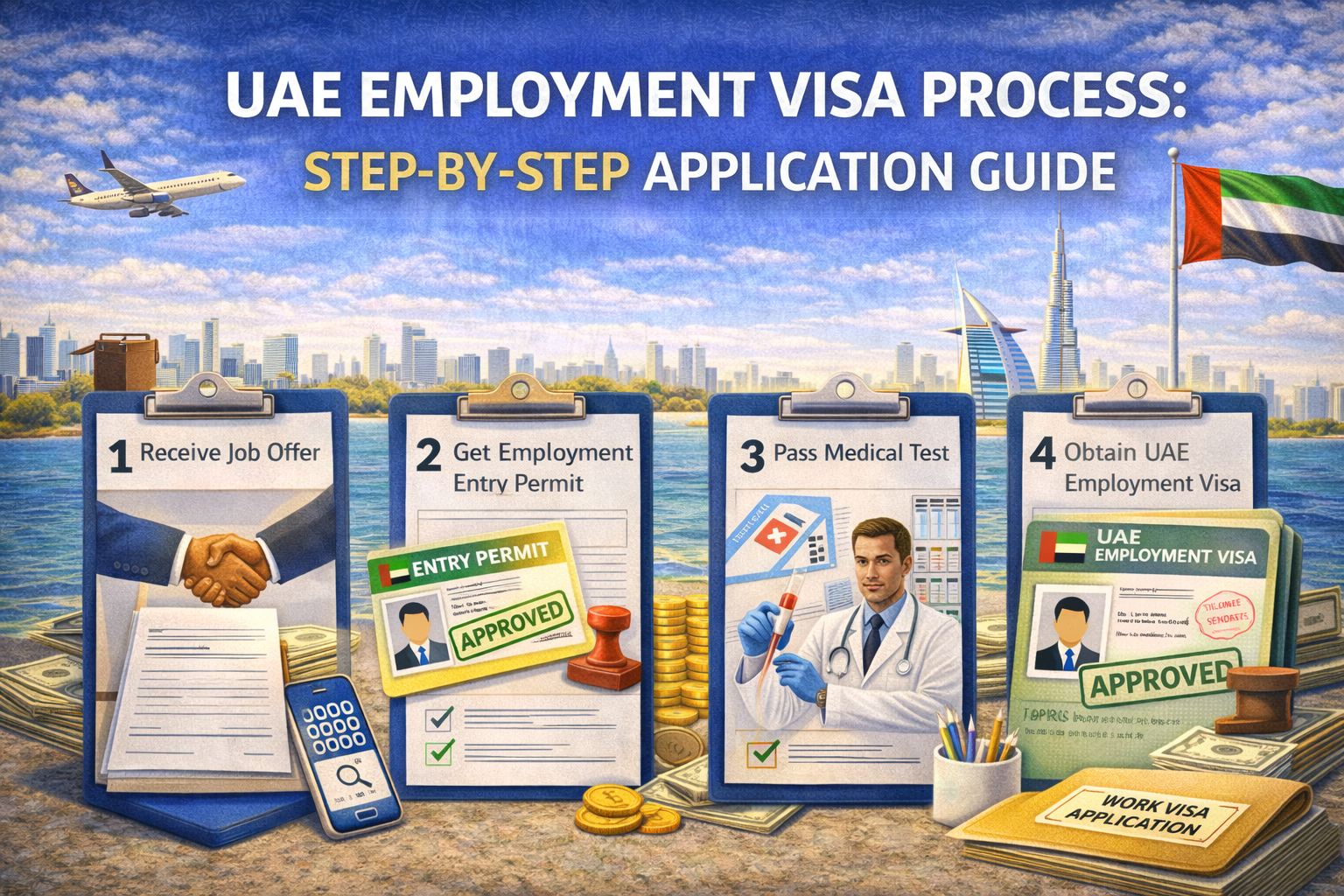
Quick Answer: The UAE employment visa process takes 2 to 4 weeks and involves 10 steps: job offer, work permit application through MOHRE, issuance of the entry permit, arrival in the UAE, medical fitness test, Emirates ID registration, submission of the labor contract, health insurance, residence visa stamping, and work permit activation. Your employer handles most of the process and pays all fees, which range from AED 3,000 to AED 7,000.
Introduction
Moving to the UAE for work is one of the best career decisions you can make. Tax-free salaries, world-class infrastructure, and access to a global business hub attract millions of professionals every year. But before you can start earning, you need to understand how the employment visa process works, including renewal and cancellation costs.
The good news is that your employer handles most of it, making the process feel manageable and supportive. The process is straightforward once you know what to expect. This guide breaks down every step, every document, and every fee so you arrive in the UAE prepared and confident.
What is a UAE Employment Visa?
A UAE employment visa is a legal document that allows foreign nationals to live and work in the United Arab Emirates under employer sponsorship. It combines a work permit (issued by MOHRE) with a residence visa (issued by GDRFA), giving you the right to stay in the country for the duration of your employment contract. Learn about renewal and cancellation processes to plan your stay effectively.
The standard employment visa is valid for 2 to 3 years, depending on your contract terms and the emirate where you work. Knowing your visa duration can help you plan your future in the UAE with confidence. Unlike a visit visa, an employment visa lets you open bank accounts, rent property, sponsor family members, and access all government services.
Two government bodies manage the process. The Ministry of Human Resources and Emiratisation (MOHRE) approves your work permit and labor contract. The General Directorate of Residency and Foreigners Affairs (GDRFA), operating under the Federal Authority for Identity, Citizenship, Customs and Port Security (ICP), issues your entry permit and residence visa.
Types of UAE Employment Visas
The UAE offers several employment visa categories based on your profession, employer type, and qualifications.
| Visa Type | Duration | Best For |
| Standard Work Visa | 2-3 years | Private sector employees |
| Free Zone Visa | 2-3 years | Employees in free zone companies |
| Green Visa | 5 years | Skilled workers earning AED 15,000+ |
| Golden Visa | 10 years | Professionals earning AED 30,000+ |
| Freelance Visa | 1-3 years | Self-employed professionals |
Related: Green Visa vs Golden Visa: Which is Right for You? (uaeinsiderguide.com)
Eligibility Requirements
Before applying for a UAE employment visa, both you and your employer must meet specific criteria.
Employee Requirements
- Minimum age of 18 years
- Valid passport with at least 6 months’ validity
- Confirmed job offer from a UAE-registered company
- Educational qualifications matching the job role (attested)
- Pass the medical fitness examination
- No criminal record (police clearance may be required for specific jobs)
Employer Requirements
- Valid UAE trade license
- Available visa quota from MOHRE
- No outstanding violations or fines
- Registered in the Wage Protection System (WPS)
- Meets Emiratisation quotas (for applicable sectors)
Required Documents
Gather these documents before your employer begins the visa application.
| Document | Notes |
| Valid Passport | Minimum 6 months validity, clear copy of bio page |
| Passport Photos | Recent, white background, passport size |
| Educational Certificates | Attested bythe UAE Embassy and the MOFA |
| Signed Employment Contract | In English and Arabic |
| Medical Fitness Certificate | Obtained after arrival in the UAE |
| Professional License | For regulated professions (doctors, engineers) |
| Police Clearance Certificate | Required for certain positions |
Step-by-Step Application Process
The UAE employment visa process follows a specific sequence. Your employer initiates and manages most steps.
- Job Offer and Contract Signing
Your employer provides a formal job offer detailing salary, benefits, and terms. Both parties sign the employment contract, which must be in English and Arabic. The contract includes your job title, salary breakdown, working hours, and leave entitlements.
- Work Permit Application
Your employer applies for a work permit through MOHRE’s Tas’heel system. They submit your passport copy, photos, educational certificates, and the signed contract. MOHRE verifies that the company has a visa quota available and approves the work permit within 2 to 5 working days.
- Entry Permit Issuance
Once the work permit is approved, you receive an Employment Entry Permit (sometimes called a pink visa) via email. This permit is valid for 60 days and allows you to enter the UAE legally. If you are already in the UAE on a visit visa, your employer applies for a status change instead.
- Arrival in the UAE
Travel to the UAE using your entry permit. Immigration stamps your passport upon arrival. You now have 60 days to complete all remaining visa formalities, including medical tests, Emirates ID, and residence visa stamping.
- Medical Fitness Test
Within 14 days of arrival, complete your medical examination at a government-approved health center—the test screens for infectious diseases, including HIV, hepatitis B and C, and tuberculosis. Results typically come back within 24 to 48 hours and are sent directly to immigration authorities.
- Emirates ID Application
Apply for your Emirates ID within 15 days of arrival. This involves biometric registration, including fingerprints and a photograph,h at an ICP-approved typing center. Your Emirates ID is your primary identification document in the UAE and is required for banking, mobile services, and most official transactions.
- Labor Contract Submission
Your employer submits the signed labor contract to MOHRE within 14 days of your medical test. MOHRE reviews and attests the contract. A digital copy will be available in the MOHRE app and on the website for your records.
- Health Insurance
Your employer provides mandatory health insurance coverage. UAE law requires all residents to have health insurance covering hospitalization, doctor visits, and medical procedures. The policy must be active before your residence visa is stamped.
- Residence Visa Stamping
After passing your medical test and completing Emirates ID registration, GDRFA stamps the residence visa in your passport. This visa is valid for 2 to 3 years, depending on your contract. Some emirates now issue digital residence visas instead of physical stamps.
- Work Permit Activation
Your work permit becomes active once all formalities are complete. You can now legally work for your sponsoring employer. Your labor card information is stored digitally and accessible through the MOHRE app.
Employment Visa Fees and Costs
Under UAE Federal Decree-Law No. 33 of 2021, employers must pay 100% of visa costs. If anyone asks you to pay visa fees, report them to MOHRE.
| Fee Component | Cost (AED) |
| Work Permit (varies by company category) | 250 – 3,450 |
| Entry Permit | 200 – 500 |
| Medical Fitness Test | 300 – 700 |
| Emirates ID (2 years) | 370 |
| Residence Visa Stamping | 510 – 560 |
| Health Insurance (annual) | 600 – 3,000+ |
| Status Change (if in UAE) | 500 |
| 65+ Age Surcharge | 5,000 |
| Total Estimated Range | 3,000 – 7,000+ |
Free zone visas typically cost 30 to 40% less than mainland visas but restrict employment to the specific free zone.
Processing Time
| Stage | Duration |
| Work Permit Approval | 2 – 5 working days |
| Entry Permit Issuance | 1 – 3 working days |
| Medical Test and Results | 1 – 2 days |
| Emirates ID Processing | 3 – 7 working days |
| Residence Visa Stamping | 3 – 7 working days |
| Total Process | 2 – 4 weeks |
Fast-track processing is available for an additional AED 500 to 1,000, reducing total time to 5 to 7 working days. Delays occur when documents are incomplete, require additional verification, or occur during peak seasons.
Medical Test Requirements
Every employment visa applicant aged 18 and above must pass a medical fitness examination.
What the Test Includes
- Blood test for HIV, hepatitis B, hepatitis C, and syphilis
- Chest X-ray for tuberculosis screening
- General physical examination
- Additional tests for food handlers and domestic workers
Approved Medical Centers
In Dubai, tests are conducted at Dubai Health Authority (DHA) approved centers, including Smart Salem facilities. In other emirates, Emirates Health Services (EHS) authorized centers handle screenings. Smart Salem offers express service with results in 30 minutes for an additional fee.
Results are sent electronically to immigration authorities. A medical fitness certificate is issued if you pass, allowing the visa process to continue. Testing positive for HIV, active TB, or hepatitis may result in visa denial.
Visa Renewal and Cancellation
Renewal Process
Employment visas must be renewed before expiry. Your employer initiates the renewal process through MOHRE, which includes repeating the medical test and updating your Emirates ID. Renewal costs range from AED 4,000 to 6,000. Late renewal incurs fines of AED 50 per day.
Cancellation Process
When employment ends, your employer must cancel your visa through MOHRE within 30 days. They first cancel the work permit, then the residence visa through GDRFA. Cancellation fees range from AED 100 to AED 300. After cancellation, you have a 60-day grace period to find new employment, change visa status, or leave the UAE.
If changing jobs within the UAE, your new employer must apply for a new work permit and visa. You do not need to leave the country if transitioning directly between employers.
Frequently Asked Questions
How long does the UAE employment visa process take?
The complete process takes 2 to 4 weeks from work permit application to residence visa stamping. Delays can extend this if documents need additional verification.
Who pays for the employment visa in the UAE?
Your employer pays all visa-related costs under UAE law. This includes work permit fees, medical tests, Emirates ID, residence visa stamping, and health insurance. If asked to pay any fees yourself, report it to MOHRE.
Can I work for another company on an employment visa?
No. Your employment visa ties you to your sponsoring employer. Working for another company without permission is illegal and can result in fines and deportation.
What happens if I fail the medical test?
Testing positive for HIV, active TB, or hepatitis can result in visa denial. Some conditions may allow for treatment and re-testing. Inactive TB with scarring may result in a conditional one-year visa with mandatory follow-up screenings.
Can I sponsor my family on an employment visa?
Yes, if you earn at least AED 4,000 monthly (or AED 3,000 with employer-provided housing). You can sponsor your spouse and children—family visa costs range from AED 3,000 to 5,000 per dependent.
How long can I stay outside the U.S. on an employment visa?
Standard employment visas are cancelled if you stay outside the UAE for more than 180 consecutive days. Golden Visa holders are exempt from this rule.
Is health insurance mandatory foran employment visa?
Yes. UAE law requires all residents to have health insurance. Your employer must provide coverage before your residence visa is stamped. MOHRE will not renew work visas without valid health insurance.
Official Sources
- Ministry of Human Resources and Emiratisation (MOHRE): mohre.gov.ae
- Federal Authority for Identity, Citizenship, Customs and Port Security (ICP): icp.gov.ae
- UAE Government Portal: u.ae
- Dubai Health Authority: dha.gov.ae
- Emirates Health Services: ehs.gov.ae
Disclaimer: This guide is for informational purposes only. UAE visa regulations change frequently. Always verify current requirements with official government sources or consult a licensed PRO service before making decisions.
Last Updated: February 2026
2 thoughts on “UAE Employment Visa Process: Step-by-Step Application Guide 2026”