
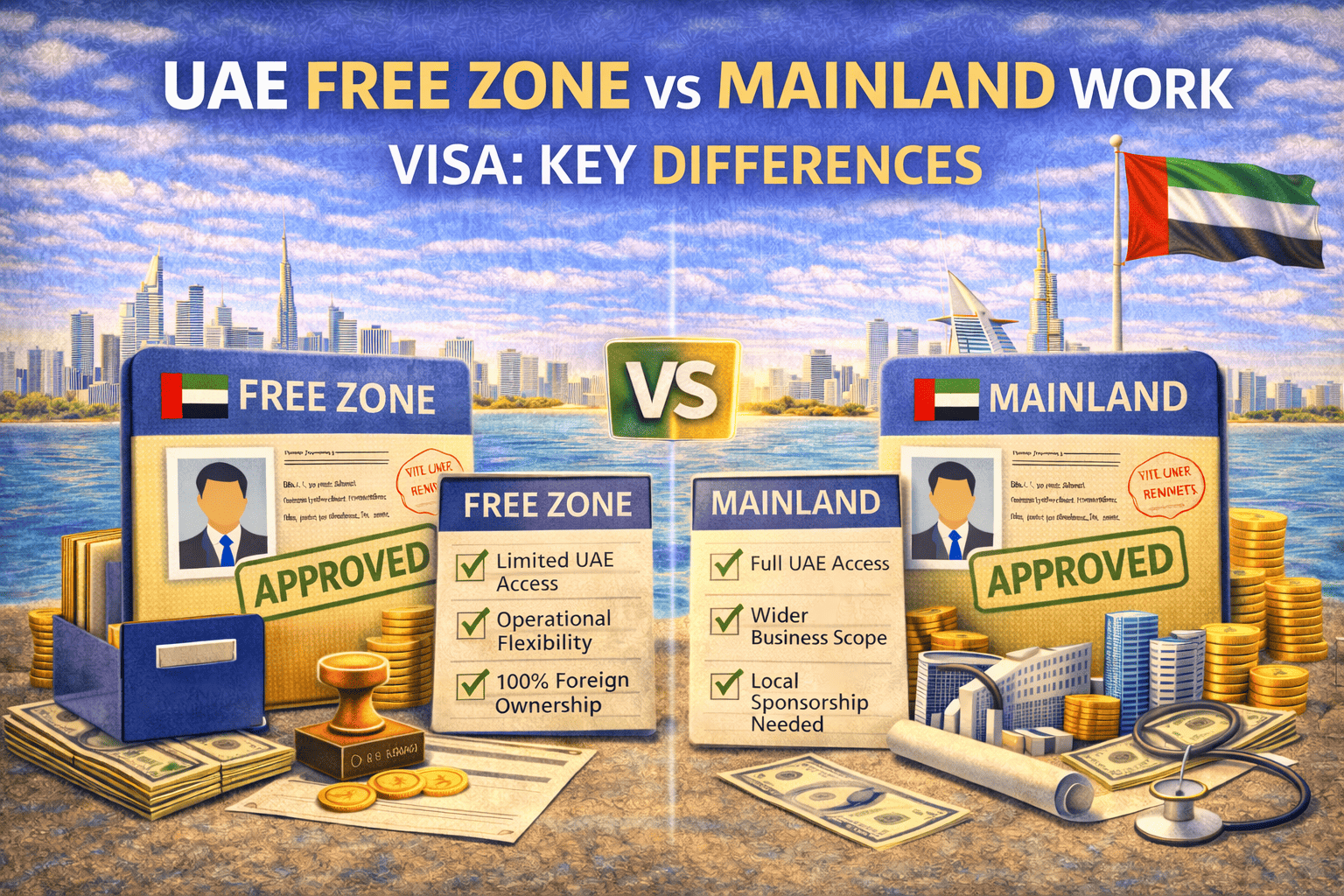
Quick Answer: Employment visas in the UAE operate under two separate jurisdictional frameworks. Free zone visas limit your employment to the specific free zone that issued them, with sponsorship handled by the zone authority rather than your employer. These typically run between AED 2,000 and 5,000, and you cannot take mainland employment without going through a complete visa transfer process.
Introduction
The UAE employment visa system splits into two distinct jurisdictional categories. This division influences your employment mobility, affecting where you can work and how easily you can switch roles or locations.
Understanding this structural difference is crucial for clarity, as it shapes your overall employment mobility and helps you plan your career path effectively in the UAE.
Sponsorship Structure
Free Zone Visa
The free zone authority acts as your sponsor, not your employer. Your company must hold a valid license issued by that specific zone. Each zone runs its own immigration processing desk with independent authority over visa issuance and cancellation. While this operates under federal immigration law, implementation happens at the zone level.
Mainland Visa
Your employer becomes the direct sponsor but must process everything through MOHRE and the General Directorate of Residency and Foreigners Affairs. The employer needs a mainland trade license. MOHRE regulations apply uniformly across all seven emirates, which creates more standardization compared to free zone variations.
Sponsorship Comparison:
| Factor | Free Zone | Mainland |
| Sponsoring entity | Free zone authority | Employer (MOHRE registered) |
| License requirement | Free zone trade license | Mainland trade license |
| Regulatory body | Zone-specific authority | MOHRE + GDRFA |
| Cross-emirate validity | No (zone-locked) | Yes (all mainland) |
Geographic Work Restrictions
Free Zone Limitations
Your employment authorization extends only to the physical boundaries of the issuing free zone. Taking mainland employment requires either a complete visa transfer or a No Objection Certificate and separate work authorization. Moving to a different free zone means starting a new visa application from scratch.
Violation carries financial penalties of up to AED 50,000 and potential deportation. Immigration enforcement has tightened significantly on this issue because companies were previously exploiting the loophole.
Mainland Flexibility
Mainland authorization permits employment anywhere within the UAE mainland territory across all seven emirates. This transparency in mobility options can help you feel more confident in your employment planning, knowing your work location is flexible within the mainland.
Location Authorization:
| Location | Free Zone Visa | Mainland Visa |
| Issuing a free zone | ✓ Permitted | ✗ Prohibited |
| Other free zones | ✗ Requires a new visa | ✗ Requires a new visa |
| Dubai mainland | ✗ Prohibited | ✓ Permitted |
| Abu Dhabi mainland | ✗ Prohibited | ✓ Permitted |
| Other emirates mainland | ✗ Prohibited | ✓ Permitted |
Cost Breakdown
Free Zone Visa Fees (2026)
The establishment card costs between AED 2,000 and AED 3,000, depending on the zone that processes your application. Entry permits run AED 500 to 1,000. Medical fitness testing costs AED 300 to 500. Emirates ID carries a fixed federal fee of AED 370. Visa stamping adds another AED 500 to 700. Typing centers charge AED 200 to 400 for document preparation.
Total range: AED 3,870 to 6,170
Mainland Visa Fees (2026)
MOHRE work permits cost AED 2,000. Entry permits cost AED 500. Medical fitness ranges from AED 300 to 500. Emirates ID remains AED 370. Visa stamping costs AED 500 to 700. Administrative and typing services add AED 300 to 500.
Total range: AED 3,970 to 4,570
Fee Comparison:
| Component | Free Zone | Mainland |
| Authority fees | AED 2,000-3,000 | AED 2,000 (MOHRE) |
| Medical + biometrics | AED 670-870 | AED 670-870 |
| Processing fees | AED 700-1,100 | AED 800-1,200 |
| Optional typing services | AED 200-400 | AED 300-500 |
| Average total | AED 4,500 | AED 4,200 |
Processing Time and Requirements
Free Zone Processing
Standard processing takes three to seven working days, though this varies by zone. Most zones offer fast-track services, which are completed within 24 to 48 hours for an additional AED 1,000. Required documents include a passport copy with a minimum validity, a degree attestation from the MOFA and the UAE embassy, an employment contract, and a free zone license copy.
Mainland Processing
Expect a total of five to ten working days. MOHRE approval takes two to four days. Post-approval processing adds three to six days. Required documents include a copy of the passport valid for at least 6 months, a degree attestation from MOFA and the UAE embassy, a labor contract using the MOHRE template, the company trade license, and the immigration card.
Processing Timeline:
| Stage | Free Zone | Mainland |
| Work permit approval | N/A (bundled) | 2-4 days (MOHRE) |
| Entry permit issuance | 1-2 days | 1-3 days |
| Medical + Emirates ID | 2-3 days | 2-3 days |
| Visa stamping | 1-2 days | 1-2 days |
| Total | 3-7 days | 5-10 days |
Visa Validity and Renewal
Free Zone
Standard validity is two years, renewable. Renewal windows open 30 days before expiration. Grace periods extend 30 days past expiration, after which overstay fines of AED 125 per day apply. Renewal costs range from AED 2,500 to 4,000. Conditions require maintaining an active free zone license and a valid labor contract.
Mainland
Two-year validity with a renewable status. Renewal windows are recommended 60 days before expiration. The grace period matches the free zones at 30 days, with identical overstay penalties. Renewal costs range from AED 3,000 to AED 5,000. Requirements include an active MOHRE work permit and continuing employer sponsorship.
Validity Comparison:
| Factor | Free Zone | Mainland |
| Validity period | 2 years | 2 years |
| Renewal advance window | 30 days | 60 days |
| Grace period | 30 days | 30 days |
| Overstay fine | AED 125/day | AED 125/day |
| Renewal cost | AED 2,500-4,000 | AED 3,000-5,000 |
| Auto-cancellation trigger | License cancellation | Contract termination |
Switching Between Visa Types
Free Zone to Mainland
Obtain No Objection Certificate from your free zone employer—technically optional but practically essential for inside-UAE processing. Secure a mainland employment offer. Your new employer then files an MOHRE work permit application. Cancel your existing free zone visa, which triggers the 30-day grace period. The transfer process typically takes 10 to 15 days and costs between AED 4,000 and AED 6,000, including visa fees and administrative expenses, helping readers plan accordingly.
Timeline: 10 to 15 days
Cost: AED 4,000 to 6,000 in new visa fees
Mainland to Free Zone
Resign from the mainland employer. Employer cancels MOHRE work permit. This activates your 30-day grace period. Free zone employer initiates a new visa application. Complete medical examination and biometrics.
Timeline: 7 to 12 days
Cost: AED 3,500 to 5,500
Transfer Overview:
| Transfer Type | Approval Required | Exit Required | Timeline | Cost |
| Free zone → Mainland | MOHRE work permit | Only if no NOC | 10-15 days | AED 4,000-6,000 |
| Mainland → Free zone | Free zone authority | No (inside transfer possible) | 7-12 days | AED 3,500-5,500 |
| Free zone → Free zone | New zone authority | Yes (unless NOC) | 7-10 days | AED 3,500-5,000 |
Frequently Asked Questions
Can I work in Dubai mainland with a DMCC free zone visa?
No. Free zone visas restrict employment to the issuing free zone. Mainland work requires a mainland visa transfer or NOC plus separate work authorization.
Which visa costs less overall?
Mainland visas average AED 4,200 compared to free zone visas averaging AED 4,500. Processing fees and zone-specific charges are the source of the variance.
Do free zone visas allow family sponsorship?
Yes, provided salary meets AED 4,000 minimum or AED 3,000 with accommodation. The process matches mainland family visa sponsorship procedures. For comprehensive details on UAE family visa requirements, refer to the UAE employment visa guide.
How long does a visa transfer between types take?
Free zone to mainland requires 10 to 15 days. Mainland to free zone takes 7 to 12 days. Both processes require visa cancellation and the submission of a new application.
Can I switch jobs within the same free zone without a new visa?
No. Employment changes require visa cancellation and reissuance even within the same free zone, unless both employers operate under the same establishment card.
Official Sources
Ministry of Human Resources and Emiratisation: https://www.mohre.gov.ae
Federal Authority for Identity, Citizenship, Customs and Port Security: https://www.icp.gov.ae
DMCC Free Zone Immigration: https://www.dmcc.ae
Disclaimer: Visa fees, requirements, and regulations are subject to change. Always verify current requirements with official UAE government sources (GDRFA, ICP) before applying. This guide is for informational purposes only.
Last Updated: February, 2026