
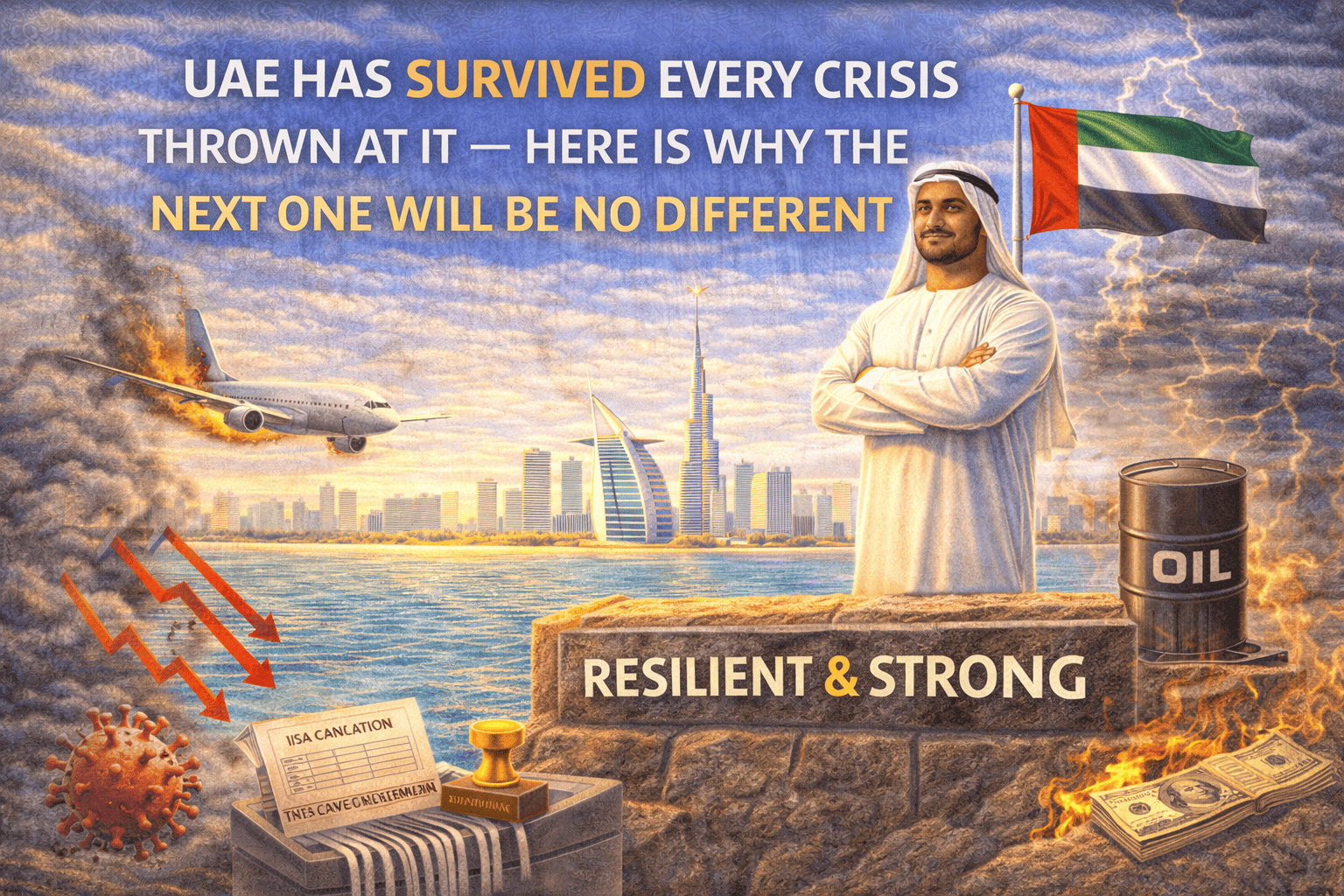
Financial collapse, a global pandemic, once-in-75-years floods, and now a regional conflict on its doorstep. The UAE’s track record across two decades says something that the headlines often miss.
If you were watching the news in 2008, you were told Dubai was finished. Property prices were collapsing. Half-built towers sat abandoned on the creek. The emirate had borrowed aggressively during the boom years, and the global financial crisis had just pulled the rug out from under it. The narrative was clear: this experiment in desert city-building was over.
It was not over. Not even close.
Seventeen years later, that same country is again at the centre of a regional storm — this time, a military and geopolitical one involving Iran and the United States, and a wider Gulf crisis that has rattled investors, spooked tourism markets, and trimmed growth forecasts. And once again, a familiar chorus of doubt has begun.
The data, however, tells a different story. It tells the story of a nation that has developed a pattern — absorb the shock, adapt faster than anyone expects, and emerge with stronger infrastructure, deeper diversification, and a more resilient economy than before the crisis hit.
A Pattern That Repeats
Understanding the UAE’s current position requires looking at what it has already survived — not in abstract terms, but in documented, measurable outcomes.
2008 — 2010: The Global Financial Crisis & Dubai’s Debt Shock
When Lehman Brothers collapsed in September 2008, Dubai was carrying enormous debt through its state-linked entities, most visibly Dubai World. By November 2009, Dubai World formally requested a debt standstill — a restructuring of nearly $26 billion in obligations. International creditors panicked. Real estate values dropped by as much as 50 percent in some segments. The global press declared Dubai a cautionary tale of speculative excess.
Abu Dhabi intervened with a $10 billion lifeline, the debt was restructured, and Dubai used the crisis to accelerate something it had already been quietly building: a diversified, services-led economy. Within three years, tourism numbers were climbing again. Within five years, the real estate market had largely recovered. The 2008 crisis did not break Dubai — it forced it to professionalise.
2020 — 2021: COVID-19 — The World’s Busiest Hub Goes Silent
For a country whose economy runs on mobility tourism, aviation, logistics, hospitality, and international business, a global pandemic was the most targeted possible threat. Dubai International Airport, the world’s busiest for international travel, was grounded. Hotels emptied. Expo 2020 was postponed. GDP contracted.
The UAE’s response was aggressive and strategic. It launched one of the fastest vaccine rollout programmes in the world, administered free of charge. It restructured visa pathways to attract remote workers and long-term talent under new residency frameworks. And it reopened to international tourists faster than almost any other major destination. Expo 2020 Dubai, held in 2021–2022, welcomed over 24 million visitors. The UAE entered 2022 with momentum that most economies would not recover until much later.
April 2024: The Floods — 75 Years of Rain in 24 Hours
On April 16, 2024, a desert nation received approximately 250 millimetres of rainfall within 24 hours — more than twice its annual average, and the heaviest precipitation recorded since weather data collection began in 1949. Roads across Dubai and Abu Dhabi were submerged. Sheikh Zayed Road was reduced to a single navigable lane. Dubai International Airport cancelled over 1,200 flights in two days.
Within days, the government announced an AED 2 billion emergency fund for flood-damaged homes. Sheikh Mohammed bin Rashid Al Maktoum then announced the Tasreef project, an AED 30 billion drainage overhaul designed to give Dubai the capacity to handle 20 million cubic metres of water daily, serving the city for the next hundred years. Contracts were officially awarded in April 2025. The 2024 floods did not reveal a broken city. They revealed a government that converts failures into engineering mandates.
2026 Present: Regional Conflict The Current Pressure Test
The escalation of tensions involving Iran and the United States, with broader Gulf security implications, has created genuine short-term uncertainty. Tourism inflows have softened. Some investment decisions are being delayed. S&P Global, while reaffirming the UAE’s ‘AA/A-1+’ sovereign credit rating with a stable outlook, revised its near-term GDP growth forecast to 2.5 percent for 2026–2027, down from an earlier projection of 4.2 percent.
But the structural story is different from the headline numbers. Non-oil foreign trade surpassed AED 3.5 trillion in 2025. The non-oil economy now accounts for approximately 75 percent of GDP. The IMF projects real GDP growth close to 5 percent through 2026. Banks are well capitalised, with strong liquidity and low non-performing loan ratios. The UAE economy grew by around 5.1 percent in the first nine months of 2025, before the current escalation fully materialised.
The Numbers Behind the Resilience
184% of GDP — UAE Government net asset position (S&P, 2026). One of the strongest sovereign balance sheets on earth.
210% of GDP — Government liquid assets, including ADIA and Emirates Investment Authority. The cushion against any shock.
75% — Share of GDP from non-oil sectors. The diversification that took decades to build is now the primary economic engine.
AED 3.8 trillion — Non-oil foreign trade in 2025, surpassing $1 trillion for the first time in history (UAE Ministry of Economy).
“Our base-case scenario remains that the UAE’s substantial fiscal, economic, and external buffers will act as an effective shield against the impact of regional conflict.” S&P Global Ratings, March 2026
Infrastructure Built for Disruption
One aspect of UAE resilience that rarely gets the attention it deserves is the deliberate construction of physical infrastructure that reduces vulnerability during crises. The Abu Dhabi Crude Oil Pipeline to Fujairah — known as ADCOP — can transport approximately half of Abu Dhabi’s oil exports directly to the Indian Ocean, entirely bypassing the Strait of Hormuz. In a scenario where Hormuz is disrupted by regional conflict, this pipeline transforms a potential catastrophe into a manageable inconvenience.
The UAE’s position as a multi-hub logistics network — connecting Europe, Asia, and Africa — gives it a geographic importance that no single regional conflict can easily erase. Companies and capital do not simply relocate away from Dubai because of tensions in the Gulf. They stay precisely because Dubai has spent decades building the systems that make it irreplaceable.
The Diplomatic Architecture
The UAE has also spent the past decade building a diplomatic layer that most of its neighbours lack. The Abraham Accords normalisation with Israel in 2020 was a significant foreign policy repositioning. Ongoing engagement with both Western allies and regional powers — including maintaining pragmatic channels with Iran even during periods of tension — gives the UAE room to manoeuvre that smaller or less strategically positioned nations do not have.
This is not an accident of geography. It is a deliberate architecture of non-alignment that allows the UAE to function as a neutral business hub regardless of which powers conflict with it.
What the Pattern Tells You
Every crisis in the UAE’s recent history has followed the same three-act structure. First: the shock is real, the disruption is significant, and the external commentary is pessimistic. Second: the government moves fast — faster than the narrative expects with capital, policy, and structural reform. Third: the post-crisis UAE is demonstrably better-built than the pre-crisis UAE.
After 2008, Dubai’s economy became more professionalised, and its diversification strategy became more urgent. After COVID-19, the UAE had new residency frameworks, faster digital infrastructure, and a tourism positioning that attracted record numbers in subsequent years. After the 2024 floods, it has a 30 billion AED drainage project that will define urban infrastructure for a century.
The current regional conflict presents real risks — to tourism, to short-term investment sentiment, and to regional supply chains. S&P’s revised growth forecast reflects those risks honestly. But the same agency simultaneously reaffirmed the UAE’s AA credit rating and described its sovereign balance sheet as one of the strongest in the world. That is not a contradiction. It is an accurate assessment of a country with short-term headwinds and exceptional long-term structural depth.
For residents, investors, and visitors navigating the current uncertainty, the relevant dataset is not this week’s headlines. It is the documented outcome of every serious stress test this country has faced in the last two decades. That record is consistent, and it points in one direction.
The UAE does not just survive crises; it thrives. It builds infrastructure with them.
REFERENCES & SOURCES
S&P Global Ratings UAE Sovereign Credit Assessment, March 2026. Reaffirmed ‘AA/A-1+’ rating with stable outlook. Via Khaleej Times, March 2026. Read article
Gulf News 6 Reasons the UAE Economy Can Withstand Iran-US Conflict Shocks,’ March 2026. Read article
UAE Ministry of Economy Non-oil foreign trade figures 2025. AED 3.5–3.8 trillion. Via Economy Middle East, March 2026. Read article
IMF Article IV Consultation United Arab Emirates, December 2025. Read report
World Bank Gulf Economic Update Fall 2025. UAE projected 4.8% GDP growth. Read report
UAE National Center of Meteorology April 2024 flood data. 250mm rainfall in 24 hours, the highest since records began in 1949. Via NASA Earth Observatory, April 2024. Read article
Wikipedia 2024 United Arab Emirates Floods. AED 2 billion emergency fund, 1,244 flights cancelled. Read article
Khaleej Times UAE Historic April 2024 Rain Flood,’ April 2025. AED 30 billion Tasreef project details. Read article
Time Out Dubai ‘Dubai Floods One Year On,’ April 2025. Tasreef engineering specifics. Read article
Economy Middle East UAE Economic Resilience: Non-Oil Growth 2026,’ March 2026. Read article
Post UAE Firms Signal Resilience Amid Regional Tensions,’ March 2026. Read article